
#Runtime Parameters
$parameter is configuration that lives in the database instead of the
environment: a named, schema-validated value you can change while the app is
running, from the admin UI or from code, with every change recorded and every
previous value still there to roll back to.
1import { $parameter } from "alepha/api/parameters";It needs an ORM connection (it stores every version in a parameters table)
and ships an admin controller, so it lives under alepha/api/ as the
AlephaApiParameters module. You rarely register that module by hand: the
first $parameter a service declares pulls it in. Register it explicitly only
when you want the admin API in an app that declares no parameter of its own:
1import { AlephaApiParameters } from "alepha/api/parameters";2 3alepha.with(AlephaApiParameters);#Which one do you want
Three things in Alepha look like configuration and are not interchangeable.
| Primitive | Lives in | Changes | Audited | Use it for |
|---|---|---|---|---|
$env |
the environment | at boot, by a deploy | no | secrets, connection strings, per-host wiring |
$atom |
process memory | at runtime, per process | no | in-process state, module options |
$parameter |
the database | at runtime, for every process | yes | numbers a human decides and later regrets |
The dividing line is who changes the value and how often. A database URL is an
$env: it changes when the deployment changes, and nobody edits it at 4pm on a
Friday. A free-shipping threshold is a $parameter: somebody in the business
decides it, changes it without a deploy, and will want to know who set it to
zero.
#Declaring one
1import { z } from "alepha"; 2import { $parameter } from "alepha/api/parameters"; 3 4class Checkout { 5 pricing = $parameter({ 6 name: "checkout.pricing", 7 description: "Thresholds the pricing team owns.", 8 schema: z.object({ 9 freeShippingAbove: z.number(),10 maxDiscountPercent: z.number(),11 }),12 default: { freeShippingAbove: 50, maxDiscountPercent: 30 },13 });14}schema must be a z.object(). default is what the parameter is worth before
anyone has ever set it, so an app boots and behaves correctly against an empty
parameters table: there is no "unconfigured" state to handle.
name uses dot notation, and the admin UI renders it as a tree, so
checkout.pricing and checkout.limits group under one checkout node. Omit
it and the name is derived as <ClassName>.<propertyKey>, which is fine for one
app and a poor idea the moment you rename the class.
#Reading it
1import { z } from "alepha"; 2import { $parameter } from "alepha/api/parameters"; 3 4class Checkout { 5 pricing = $parameter({ 6 name: "checkout.pricing", 7 schema: z.object({ freeShippingAbove: z.number() }), 8 default: { freeShippingAbove: 50 }, 9 });10 11 async shippingCost(total: number) {12 const { freeShippingAbove } = await this.pricing.get();13 return total >= freeShippingAbove ? 0 : 4.9;14 }15}get() is async, and it is async for a reason that is not "it hits the
database on every call". The first call loads the row and caches it; later calls
are served from memory. Being async is what lets that first load happen lazily,
which is what makes the primitive work on Cloudflare Workers, where there is no
boot phase in which to preload anything. On a long-lived Node process the
provider does preload: on ready it loads (and, if the schema changed,
migrates) every registered parameter, so the first request does not pay for it.
Two synchronous accessors exist for code that cannot await:
cachedCurrentContentreturns the cached value, falling back to the default.isUsingDefaultistruewhile no stored value is in the cache: either nothing was ever stored, or nothing was loaded yet.
Neither triggers a load. In a request handler, await get().
#Changing it
1import { z } from "alepha"; 2import { $parameter } from "alepha/api/parameters"; 3import type { UserAccount } from "alepha/security"; 4 5class Checkout { 6 pricing = $parameter({ 7 name: "checkout.pricing", 8 schema: z.object({ freeShippingAbove: z.number() }), 9 default: { freeShippingAbove: 50 },10 });11 12 async raiseThreshold(user: UserAccount) {13 await this.pricing.set(14 { freeShippingAbove: 75 },15 {16 user,17 changeDescription: "Q4 margin protection",18 tags: ["pricing"],19 },20 );21 }22}Every set() writes a new version rather than updating a row. user is what
puts a name on it, and changeDescription is what makes the history readable six
months later. Both are optional and both are the difference between an audit
trail and a list of timestamps.
Immediate writes refresh the writing process's cache before returning, whether
they come from set(), the admin API, or ParameterProvider.save(). Subscribers
receive the validated value when it changes.
#Scheduling a change
activationDate in the future stores the version without making it current:
1await this.pricing.set(2 { freeShippingAbove: 0 },3 {4 activationDate: new Date("2026-11-27T00:00:00Z"),5 changeDescription: "Black Friday",6 },7);There is no stored status field and no job that flips one. A version's status is
derived from its activationDate every time it is queried, so "pending" becomes
"current" because the clock moved, not because a process was running at the
right moment. An app that was switched off over the weekend comes back with the
correct value.
Each version's status, as the history and the admin UI show it:
| Status | Meaning |
|---|---|
current |
the latest version whose activationDate has passed |
next |
the earliest version whose activationDate is in future |
future |
any later scheduled version |
expired |
every other past version |
A running process holds the next version in memory too, and the first get()
after its date switches to it without a database round trip. The switch calls
that process's sub() callbacks when the value changed, and publishes nothing:
each instance switches on its own get().
#Reacting to a change
Other processes do not poll. An immediate set() publishes on a topic
(parameter:sync), and every other instance reloads the row:
1const unsubscribe = this.pricing.sub((value) => {2 this.log.info("pricing changed", { value });3});sub() returns its own unsubscribe function. The callback runs on every
instance whose cached value a save, a reload or a scheduled switch actually
changed, so treat it as a cache invalidation signal rather than a place to do
work once.
#How long a change takes to land everywhere
The topic rides the queue provider, which is in-memory by default. On a single
long-lived Node process that is instant and this section does not apply. On a
serverless runtime it does not apply either, for the opposite reason: many
isolates serve the same app, and a set() handled by one of them never reaches
the others.
So the cache also expires. get() re-reads the row once the cached value is
older than PARAMETERS_CACHE_TTL_MS, which defaults to 30 seconds on
serverless and to 0 (never revalidate) elsewhere. A flip therefore reaches
every isolate within about half a minute, and an operator who reloads the page
one second after saving may still see the old behaviour.
Say so wherever an admin flips something that a human will immediately go and test. A switch that appears not to have worked gets flipped again.
#History, and the version that was in force
1const history = await this.pricing.getHistory({ limit: 20 });2const v3 = await this.pricing.getVersion(3);3await this.pricing.rollback(3, { user, changeDescription: "revert bad edit" });rollback() does not delete anything. It copies the target version's content
into a new version at the head, so the mistake and the reversal are both in the
history. delete() is the one call that does: it removes every version of the
parameter, which then reads its default again. reload() forces a re-read
from the database without waiting for the cache to expire.
getHistory(), getVersion() and getVersionAt() return stored rows, not bare
values: the value is in content, next to version, activationDate,
changeDescription, tags, creatorName and previousContent.
getVersionAt() is the one worth knowing about:
1const row = await this.pricing.getVersionAt(capture.recordedAt);2const rules = row?.content ?? this.pricing.options.default;Use it when a decision belongs to the time of an event rather than the time
of the read. An offline capture uploaded three days late must be evaluated
against the values that were live when it happened, not today's. It returns
null when the timestamp predates version 1, and it is never cached: every
call is a query.
#Changing the schema
The schema is hashed and the hash is stored with each version, so the provider knows when the code's shape has moved away from the database's. On the next load it runs a cascade, and takes the first step that produces a value the new schema accepts:
- your
migrate(old)function, if you wrote one - the stored value with unknown keys stripped
- the stored value shallow-merged over
default default
Steps 2 to 4 handle the ordinary cases for free: a field you removed is dropped,
a field you added arrives with its default. Write migrate only when a value has
to be transformed, such as a rename or a unit change:
1import { z } from "alepha"; 2import { $parameter } from "alepha/api/parameters"; 3 4class Checkout { 5 pricing = $parameter({ 6 name: "checkout.pricing", 7 schema: z.object({ freeShippingAboveCents: z.number() }), 8 default: { freeShippingAboveCents: 5000 }, 9 migrate: (old) => ({10 freeShippingAboveCents:11 ((old as { freeShippingAbove?: number }).freeShippingAbove ?? 50) * 100,12 }),13 });14}A migrate that throws, or that returns something the schema rejects, is
logged and the cascade falls through to step 2. It cannot break a boot, which
also means it can fail quietly: check the logs after deploying one.
The migration itself is written as a new version, with a description saying which step produced it, so a value that silently reset to defaults is visible in the history rather than inferred from behaviour.
#The admin API
AlephaApiParameters registers AdminParameterController, whose actions live
under /api/parameters (the $action prefix), gated by five permissions:
| Permission | Grants |
|---|---|
admin:parameter:read |
the tree, the list, one parameter, its history |
admin:parameter:create |
writing a new version |
admin:parameter:rollback |
rolling back to an earlier version |
admin:parameter:activate |
activating a pending version immediately |
admin:parameter:delete |
deleting a parameter and all its versions |
Split deliberately: the people who should be able to read a threshold are not always the people who should be able to change it, and the person who can change it is rarely the person who should be able to delete its history.
| Route | Permission | Does |
|---|---|---|
GET /api/parameters/tree |
read |
the dot-notation tree, with each node's origin |
GET /api/parameters |
read |
every stored name |
GET /api/parameters/:name |
read |
current, next, default, JSON schema |
GET /api/parameters/:name/history |
read |
every version, with its status |
GET /api/parameters/:name/versions/:version |
read |
one version |
POST /api/parameters/:name |
create |
a new version, immediate or scheduled |
POST /api/parameters/:name/rollback |
rollback |
a new version copying targetVersion |
POST /api/parameters/:name/activate |
activate |
a new, immediate version copying a pending one |
DELETE /api/parameters/:name |
delete |
every version of one parameter |
POST /api/parameters/delete |
delete |
every version of several parameters |
A few behaviours worth knowing:
- Reading a registered parameter that has no row yet seeds version 1 from
its
default("Auto-seeded from compiled defaults"), so the admin always has a concrete row to edit and roll back to. - The tree marks each name
registered(declared in code, never saved),orphan(stored, but no$parameterdeclares it any more, typically after a rename) orboth. - Writes from the admin are validated against the registered schema, and the
version records the user's
username(oremail) as its creator. - Admin writes are audited when you opt in with
alepha.with(ParameterAudits)(fromalepha/api/parameters, it pulls in the audits module): every create, rollback, activate and delete is then logged as aparameteraudit event. Without it, auditing is skipped silently. Writes made from code withset()are not audited; their version history is the record.
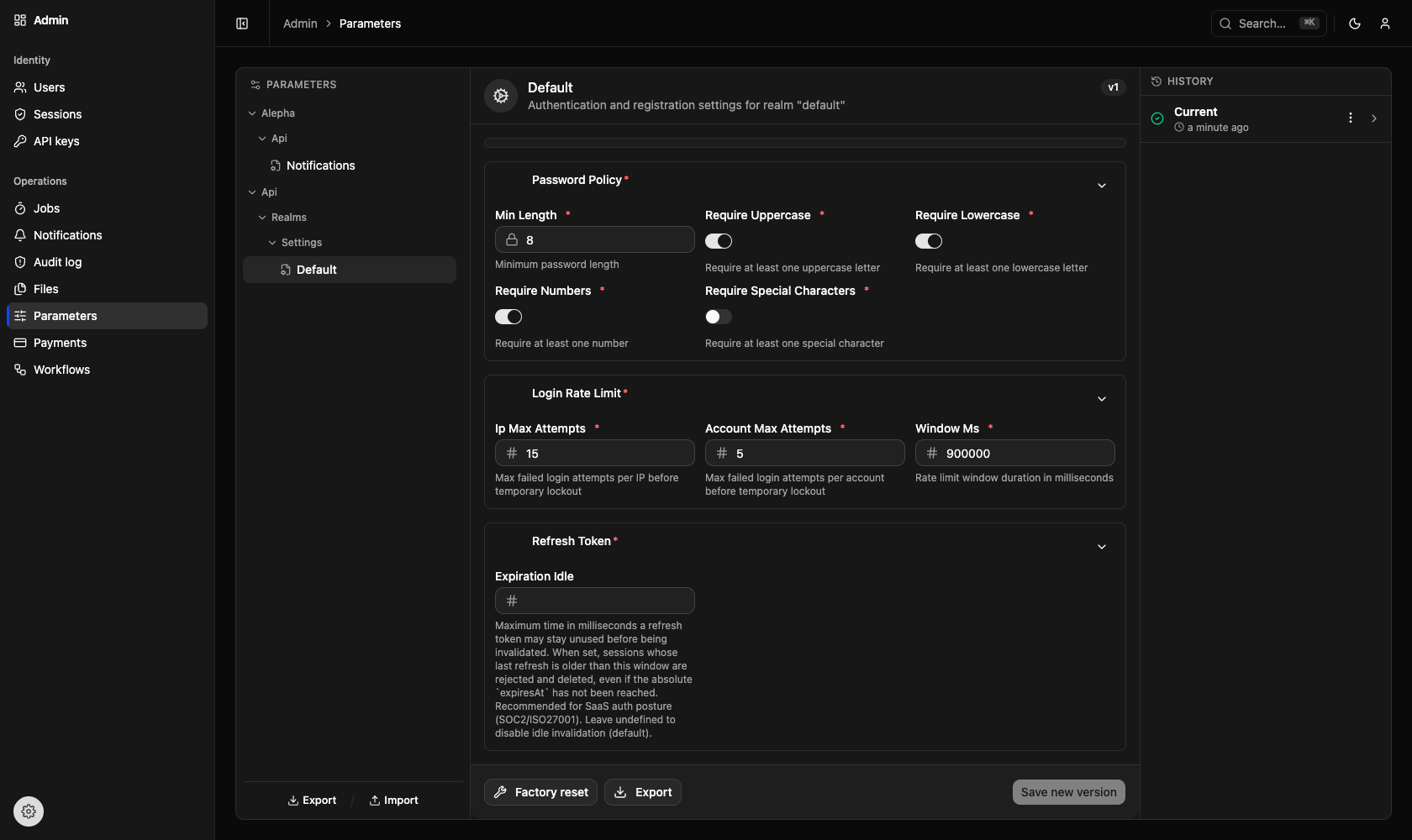
The @alepha/ui admin ships the screen for
this API: a tree on the left, the current value as a form generated from the
schema, and the version history.
#See also
- Configurations for
$envand$atom - Caching for values you want fast rather than governed
alepha/api/parametersfor the full API reference